

The Genesis Mission: Federal AI Initiative Explained
What the Federal Government's Genesis Mission Means for American Innovation
In a move that the White House compares to the historic Manhattan Project of World War II, the federal government has launched a massive, coordinated national effort called the Genesis Mission. But instead of focusing on nuclear energy, this project is laser-focused on one thing: Artificial Intelligence (AI).
This initiative is a landmark investment in accelerating scientific discovery and securing global technology dominance. While the term “Executive Order” might sound intimidating, the goal is actually quite simple: to bring together America’s best scientists, largest datasets, and most powerful supercomputers to solve the biggest challenges facing our nation today.
Think of it as turning the world’s most advanced AI into a high-speed virtual lab assistant for every single Federal research program, from energy to medicine.
A National AI Push: Why the Urgency?
The United States government sees the race for global AI leadership as the defining contest of the century, essential for national security and economic future. The Genesis Mission is the official response to this worldwide tech race, recognizing that a unified, aggressive approach is required to stay ahead.


The core idea is to transform decades of taxpayer investment into federal research data—the world’s largest collection of its kind—into a single, powerful engine. Currently, data is often scattered across different agencies (like NASA, the DOE, and others). The Genesis Mission is designed to pool these resources onto a single, secure platform, making it immediately available for AI programs to analyze and learn from.
This is not about replacing human researchers, but about giving them an unprecedented tool. AI can test millions of possibilities and process complex simulations much faster than any human team, drastically speeding up the pace of scientific discovery—a concept known as AI-accelerated innovation.
How the Genesis Mission Actually Works
The entire project is run primarily by the Department of Energy (DOE) and centers on a cutting-edge digital infrastructure called the American Science and Security Platform (or simply “The Platform”).
Imagine The Platform as the ultimate secure sandbox for innovation. It’s a unified hub that brings together three essential components:
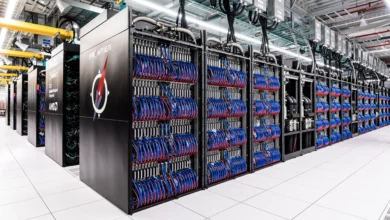
- The Supercomputing Muscle: This includes the world-class supercomputers at the DOE National Laboratories and secure cloud-based AI environments. This computing power is necessary to run the immense calculations required for large-scale AI models.
- The Datasets: This is the decades of secure, federal scientific data—everything from material science reports to biotechnology findings—all digitized, standardized, and made accessible to the AI.
- The AI Agents: These are specialized, intelligent programs, like next-generation versions of chatbots, but focused entirely on science. These AI agents are trained on the massive datasets to act as virtual researchers. They can automatically test new hypotheses, evaluate experimental results, and automate entire research workflows.
By integrating computing power, data, and intelligent agents, The Platform is designed to deliver breakthroughs that were previously impossible due to the sheer complexity and time required.
The Big Problems Genesis Aims to Solve
The focus of the Genesis Mission is on high-impact areas that directly affect our daily lives, economy, and national security. The project has identified at least 20 initial challenges spanning critical domains:
Advanced Energy and Security
A major priority is securing America’s energy future. This involves using AI to accelerate the research and design of next-generation nuclear technologies, specifically nuclear fission and fusion. Faster, cheaper, and safer energy solutions are a primary goal. The Platform will also be instrumental in strengthening national security by providing advanced modeling and analysis tools.
Materials and Manufacturing
The mission focuses on developing critical materials and improving advanced manufacturing processes. This means using AI to design new, lighter, stronger, and more efficient materials for everything from jet engines to consumer electronics. It also includes optimizing production processes to make American manufacturing faster and cheaper than ever before.
Biotechnology and Microelectronics
The AI is tasked with revolutionizing areas like biotechnology (accelerating drug discovery, improving crop yields) and optimizing the design of semiconductors and microelectronics. This last point is crucial for reducing reliance on foreign supply chains for the chips that power every modern device.In short, the Genesis Mission is a massive, highly technical effort, but its essence is simple: the federal government is placing a multi-billion dollar bet that AI and supercomputers are the fastest route to solving America’s most complex challenges, boosting innovation, and securing our place as a global technological leader.



Your passion for your subject matter shines through in every post. It’s clear that you genuinely care about sharing knowledge and making a positive impact on your readers. Kudos to you!
You’re so awesome! I don’t believe I have read a single thing like that before. So great to find someone with some original thoughts on this topic. Really.. thank you for starting this up. This website is something that is needed on the internet, someone with a little originality!
Very well presented. Every quote was awesome and thanks for sharing the content. Keep sharing and keep motivating others.