E-Waste: Corporate Sustainability’s ESG Blind Spot
As each year passes, businesses around the globe create a tremendous amount of glossy Environmental, Social, and Governance (ESG) reports. Each of these reports typically includes statements of commitment, plans, and even progress graphs highlighting everything from solar panels installed on company rooftops to water conservation and tree planting. All of this is great; it shows intent. However, upon closer inspection, a glaring omission exists – something that hums in every office, plant, and warehouse around the globe: electronics. Laptops, printers, routers, computers, phones, screens (e-waste) – the digital foundation of all businesses today.
The Unseen Electronic Waste Mountain
Why do we praise our companies for their ability to reduce their energy consumption and carbon footprint while saying nothing about what happens when the hardware becomes obsolete? Perhaps it is because e-waste is seen as overly technical, unmanageable, and too difficult to understand visually. As such, it does not lend itself to easy representation in a pie graph or in a “carbon footprint” dashboard.
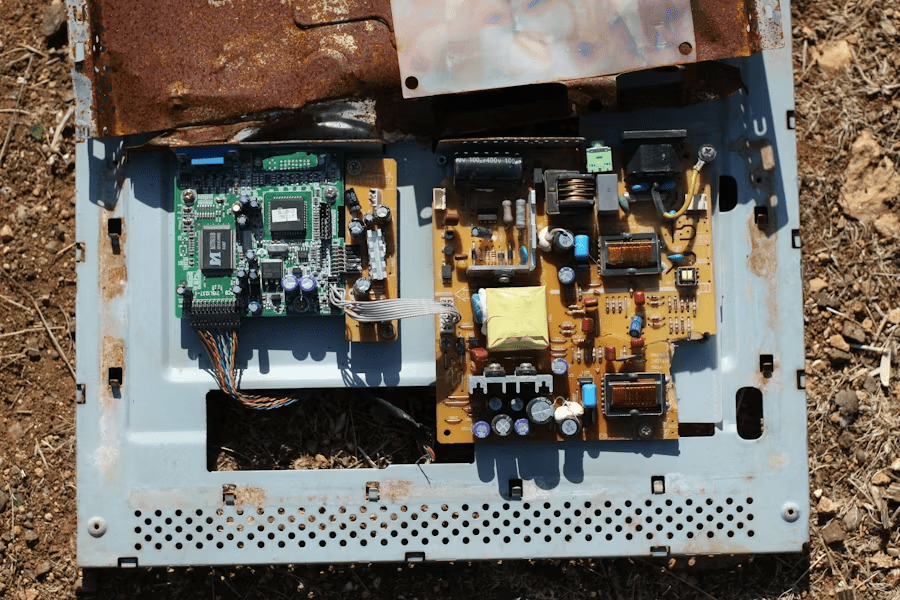
However, simply turning a blind eye to the issue does not cause the electronic waste mountain to go away. Used equipment piles up in storage rooms or is shipped to other countries as “used equipment.” In reality, much of this used equipment ends up in landfills or incinerators operated by informal electronic recyclers, releasing toxic chemicals into the earth and the atmosphere. Ironically, the very same companies that publicly tout their efforts to help clean the environment are also creating this electronic waste.
Why the Lack of Accountability for E-Waste
We are going to give businesses a break here. There is no universally accepted method of accurately measuring and tracking e-waste. Electricity usage and emissions of fossil fuels are calculated and reported in a standard way, but not so with e-waste. Oftentimes, e-waste is managed by the IT department and/or a third-party vendor, which creates a disconnect between the e-waste issue and the sustainability team.


There is also a perception issue. Some companies still view hardware disposal as an operational rather than an environmental concern. Sustainability teams continue to focus on renewable energy and social responsibility, including labor practices and supply chain ethics. Thus, the growing electronic waste mountain remains unseen in the background until someone takes responsibility for it.
A Hidden Opportunity for Sustainable Leadership
Fortunately, the problem of e-waste can be turned into a major sustainability win for companies over the next ten years. If disposed of responsibly, e-waste can be returned to the value chain. For example, precious metals such as gold, copper, and palladium can be recycled. Computers, devices, etc., can be refurbished and donated. Components can be reused.
While this is not simply a waste management issue, it represents a form of circular design thinking. Companies that engage in circular design thinking are reducing their negative impacts and also demonstrating sustainable leadership. They are presenting to investors, regulatory agencies, and customers that their commitment to sustainability is a whole-systems approach that encompasses sourcing, production, distribution, and, ultimately, disposal.
What Can Businesses Do to Engage in Responsible Disposal of E-Waste
Businesses do not need to establish a new department or incur large expenditures to begin addressing this issue. First, map where your retired technology goes. Next, ask your IT provider for documentation verifying that they properly destroyed your data and recycled your electronics. Next, please include a detailed description in your following ESG report of how your electronics are managed throughout their entire life cycle, including refurbishment and reuse. Even better, partner with a local recycler that uses environmentally friendly methods to recycle your electronics. Simply acknowledging that you have a process for managing your e-waste is a transformational step for both your employees and your stakeholders. It transforms the idea of old equipment into a representation of your accountability.
From Compliance to Culture
Sustainability is a mindset that changes behavior and culture when it transcends mere compliance. E-waste may be the blind spot for sustainability today, but it is also the emerging frontier of green technology innovation. Already, forward-thinking companies are integrating digital product stewardship into their ESG road maps.
So, ask yourself: if your sustainability report were audited based on what it included as well as what it did not include, how comprehensive would your story be?
Tomorrow, the companies that will differentiate themselves are those that are willing to identify every hidden pile, every overlooked corner, and refuse to leave anything out of their sustainability stories.
True sustainability is not about achieving perfection; it is about awareness, accountability, and the desire to confront what has been ignored. And that is the type of progress that looks good on paper – it changes the world.